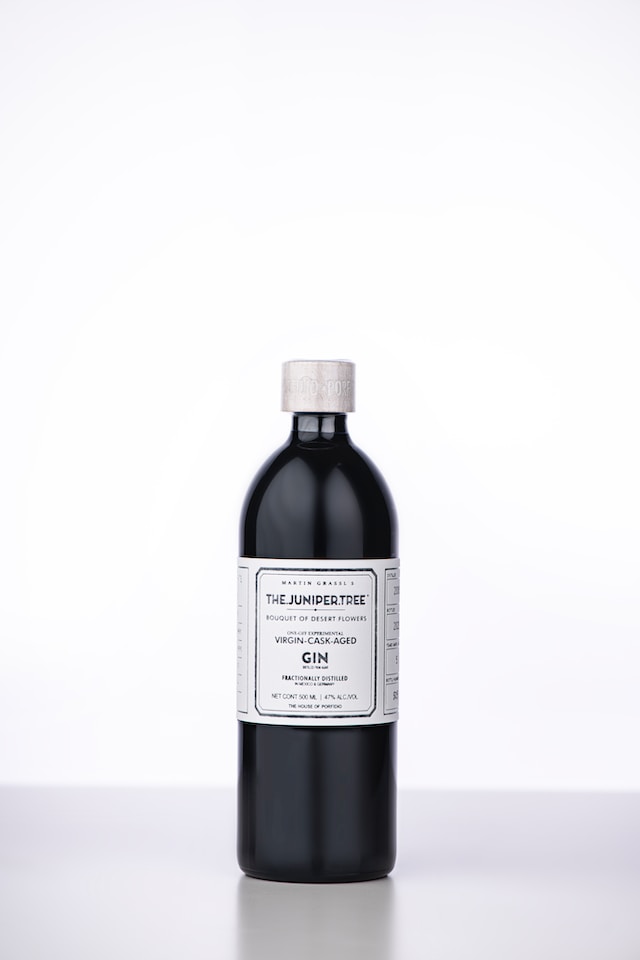
Description:
PERSPECTIVE Gin is unquestionably the most versatile, free-spirited, liberal, and innovative of spirits since it allows distillers such scope for creativity. Gin is free of any formulaic restraints imposed by governments, cartels, or closely pre-defined cultural consumer expectations. It is a natural partner for the other love of my professional life - the agave and its distilled essence. To be a gin, a spirit must legally contain 'noticeable" aroma notes of juniper, even though the law does not define just how noticeable, but apart from that one condition, a gin distiller has: • Uninhibited choice of the raw agricultural source for the base alcohol. It can be grains, grasses, fruits, vegetables, roots • Freedom to use any types and classes of the aromatizing elements: herbs, berries, fruits, grasses, woods • Liberty to pick the method for instilling these: vapor infusion, macerated and redistilled alcoholic infusions, or actual fermentations & distillations of the components • Free choice of technology: column, pot, hybrid or vacuum still • Open distilling methodology: 'all-in-one' or 'fractionally distilled' • No geographic limits on where the aromatizing elements, the base alcohol, the juniper come from; or on the place of distillation, ageing and bottling • No prescriptions for ageing - itself optional - in terms of barrel size, type, or wood variety For us, gin is the cultural and legal antithesis to Appellations Controlees, on the philosophical front line between Adam Smith's Invisible Hand on the one hand of the spectrum and, on the other, the bureaucratic paradigm exemplified by Tequila or Chianti cartel regimes that regulates everything down to the minutest detail. So, politically, gin is, in essence, the pro-free trade, anti-monopoly, anti-nationalistic, apolitical, pro-global, pro-grass-roots spirit par excellence. AC-classified spirits are usually made by a cabal of large distillers with an iron grip on the licenses and trade, but in contrast, many thousands of smaller, grass-root distillers throughout the world compete freely against each other to make gin. Today, probably for those reasons, gin is the developed world's most fashionable, contemporary spirits category. "GIN" AS IN "CULINARY DIALECTICS" Whatever gin distillers may argue, juniper has an apothecarial, medicinal whiff to it, which is not necessarily a good thing. Centuries before it became a convivial spirit, distilled juniper was peddled as an antiviral panacea for good health in Europe and the Middle East. However, juniper has also been proactively sought out for centuries as a flavoring for dishes, from Scandinavia to the Alps. The culinary purpose is to temper something too overtly sweetish with a hint of astringency from the juniper to arrive at an ideal middle ground by creating a novel syncretic flavor from the extremes. Dialectical dishes like sweet & sour pork, chicken-chocolate mole, or cranberries-with-juniper venison sauces, exemplify such integrated culinary contrasts, as does the simplistic and mundane suggestion that dry gin should be mixed before consumption with sugary tonic water for a similar effect. This dialectic inspired us in drafting our formula and, with unfeigned modesty, we would assert that The.Juniper.Tree by Porfidio is indeed a formidable example of the new dialectical gin standard! So instead of reducing the juniper content to a bare minimum like many contemporary dry gins, we deliberately boosted the aroma with fresh, fermented juniper and then subtly harmonized it with another five components to develop the ultimate gin experience, where the juniper fulfills the quintessential role of a fulcrum to lever the other elements. PRODUCT FEATURES Our agave gin formula was probably the most gamesome thing we ever did in our company's history, so fun is a key ingredient! But there is more to it. While drawing on our Mexican roots in agave spirits making, after a decade of experimenting with a wide palate of available plant material and processing techniques, we retreated to the desert and made cacti and succulents our chosen thematic botanicals. Our chosen spectrum of aromatic elements is: • Firstly and essentially: fermented and distilled fresh juniper berries (as opposed to an infusion of dried juniper, the common standard for gin) • Then we add the other corners in creative dissonance to the juniper: 1. Agave flowers, 2. Tuna cactus flowers, 3. Pitaya cactus flowers. Each of these is macerated in agave spirits and redistilled • These four fractionally distilled elements are then suffused together with unfermented agave stem juice (previously fortified with agave spirits), the Fifth Element, and aged for 5 years in virgin Castanea Saliva barrels, adding the Sixth Element, the undertones extracted over time from the toasted chestnut wood cask staves BEST-CONSUMED-AS Please note that ours is no London-style Dry Gin, to be consumed with Indian tonic water to ward off malaria, its historic purpose! Our gin makes a truly horrible mix with tonic. However, it is our earnest prescription for outstanding Negronis, Old-Fashioneds, and Martinezes, the new fashions in gin mixology. Or drink it on the rocks like any great cask-aged spirit, which is the way most of our fans (and we) like it! ALSO AVAILABLE: LIMITED ULTRA-LUXURY KUTANI EDITION Available only once per year to duty-free, this limited edition presents itself in a Kutani porcelain bottle. Kutani, also known as the "five-color porcelain," is the world's most technically challenging, process-intensive, expensive porcelain, as each color is baked separately, at different temperature levels and for different periods, onto the clay. This unique process that imbues Kutani porcelain with its trademark shiny colors is not found in Limoges, Meissen, or Wedgewood, which, despite their admitted merits, lack Kutani's tactile dimension. Embracing the Day of Love, universally symbolized by gifting flowers, we decorated our Valentine's Day bottle, appropriately, with a melange of desert flowers in the most vivid colors. ALSO AVAILABLE: LIMITED RETRO EDITION This retro edition comes in a hand-blown glass bottle made in Tlaquepaque, Mexico, in 1992. We discovered these long-forgotten treasures in our cellar in Mexico during the enforced Covid Pandemic warehouse clean-up! The bottle offers a glass quality that no longer exists, made from melted-down old-style Coca-Cola bottles with the "dirty-imperfect" greenish tinge of three decades ago. The glass was made with coal-heated furnaces and then annealed in the old-style sand caves, which also no longer exist. Coal furnaces give artisanal glass its unequivocal flair of shininess, its typicity, yet also a hint of fogginess in an appealing aesthetic contradiction. Because of the free-style hand-blowing process, each bottle has a variable shape and filling capacity, ranging from anywhere between 500 ml to 700 ml. In German, we call such a product an Unikat, a word more closely defined even than the English term "unique," since it refers to a singular object that only exists once in one entity and is inimitable for reproduction in the future. LINGUISTIC & BOTANICAL NOTES "Pitaya" is also known as "dragon fruit", and sometimes also spelled as "Pitahaya." 'Tuna" is also known as "prickly pear." "Castanea Sativa" is also known as "chestnut wood" (a tree of Mediterranean origin). "Agave stem" is also known as quiote (the long, erectile pole that grows out of the agave once the agave approaches maturity).